Showing posts with label live simply. Show all posts

Tuesday, April 12, 2011

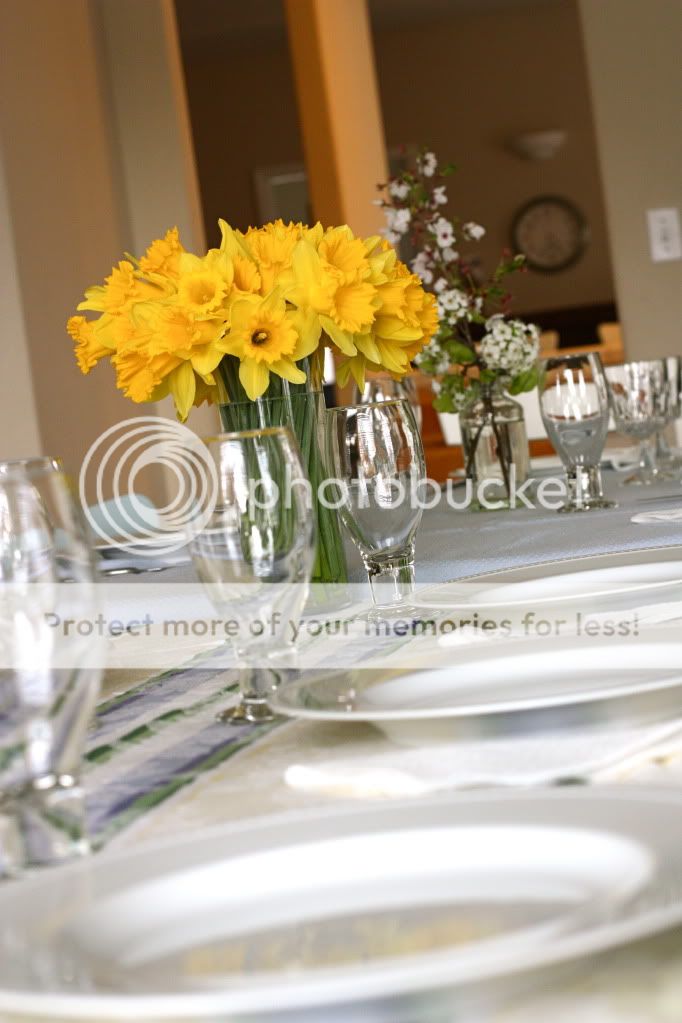
Welcome Spring


Daffodowndilly

She wore her yellow sun-bonnet,
She wore her greenest gown;
She turned to the south wind
And curtsied up and down.
She turned to the sunlight
And shook her yellow head,
And whispered to her neighbour:
"Winter is dead."

- A.A. Milne

I used to be a tulip girl. No question. But this spring I'm totally smitten by the daffodils - so cheerful and unapologetic, bursting yellow and happy. Harbingers of warm, good things to come.


Sunday night we gathered, an even dozen of us. We welcomed Spring. We did it with daffodils, and sprays of spring blossoms gathered from neighborhood trees, maple glazed ham, potatoes swaddled in cream, butter and cheese, spinach salad, warm rolls, beautiful berries dolloped with cream, and lemon cake for dessert - it was all as delicious and fragrant and wonderful as Spring herself. I loved filling two tables with guests; I loved their contributions to the meal. We visited about sundry things as late afternoon sun poured in through the front windows. If it had been just our family I would have read something - a poem (Daffodowndilly, perhaps) or an excerpt of inspiration, but I felt a little sheepish in mixed company. Still, I like the idea of entering a new season with new purpose, and taking an evening to be deliberate about it.


Winter brought lots wonderful things for our family, plenty to rejoice in and be thankful for. But it also brought a lot of rain and low hanging clouds, the oppression of tax season (my husband is an accountant), and some doldrums (as can be expected when January fades bleakly into February with more damp grey and chill). In some ways, I feel like we need to shake off the winter stupor and rededicate ourselves to the life we imagined. So once April 15th is in our rear view, we're going to take some cues from Spring and have a family pow wow about renewal and fresh starts. I think I'd like to make it a tradition to welcome this lovely time of year with a proper dinner and an evening of discussion about beginning anew - heaven knows we've all forgotten about our New Year's Resolutions.

Welcome, Spring!

p.s. you want to make that lemon cake for your Welcome Spring dinner. Trust me. Recipe here.

Wednesday, August 11, 2010

Clothespin Apron Tutorial

We're so happy to have Bloom guest Chris of Pickup Some Creativity here today to share a fun, useful apron tutorial. Enjoy!

Hello fellow Bloom readers. I'm honored and excited to be here today. My name is Chris. I write about my thoughts on creativity--both my own and my family's--at Pickup Some Creativity. My husband and I have been married for almost 11 years, and have four children ages 9 to 2. We currently live in the country in Southern Idaho, a big change for this city girl, but we've really enjoyed it.

Last year my husband bought me a clothesline. It is one of those umbrella versions, that we can take down when we mow the lawn and during winter. I love it. Hanging clothes on the line gives me a chance to slow down for a moment. The simple task allows my mind to work out problems, ponder solutions, and I can keep an eye on my children playing outside. Bonus, it saves on utility expenses too.


Not so flattering photo of me courtesy of the Idaho winds and my 9 year old.

I had a clothespin bag, but it was not convenient with a turning clothesline. So, I decided to make an apron. My friend Caroline made a clothespin apron, and I'd seen this clothespin apron a while back, so this is my take. I used part of my husband's worn-out jeans, and other materials I had on hand from making an apron for a wedding gift. So, this was an on-hand project.

You'll need the following materials:

  • BIG jeans to cut up

  • Fat quarter of a favorite fabric

  • 2 yards bias tape

  • 90 inches of 3" wide strip fabric for tie

  • Your sewing tools, including your iron and ironing board.


Step one. Cut out your pieces.

For the main body of the apron, cut along one of the seams to open up a leg of your worn-out jeans. Lay it out, and then trim so you have a square about 15" by 16".


Your fat quarter will be the large pocket. Cut a square 15" by 15". Then cut as shown here, to create the pocket openings.

It should look like this when it is cut out:


Next, cut your tie fabric. If you don't have a 90" long piece of fabric, cut as long a strip as you can, and join them together like this:


Step two. Prepare the pocket.
Carefully pin two pieces of bias tape to cover the curved edges of the pocket openings. Sew into place.


To make sure I'm sewing everything in place where I want it, I like to sew the bias tape as shown, then fold over and topstitch. The final product looks like this:


Step three. Attach pocket to denim. The nice thing about using jeans is you can use the original hem. To attach the pocket, I sewed and zigzag stitched the bottom of the pocket to the jean square right sides together. It's hard to tell with this picture (sorry!) but the hem is covered by the fabric here.


Now fold the fabric back up, and topstitch over the seam you just sewed.


Pin the sides of the apron together, and baste in place. Next, use the bias tape to finish the sides of the apron. I started the tape 0.5" below the edge of the apron, and fold over as shown to cover the bottom edge.


Sew just you did the pocket edges.


Step 4. Attach the tie.
To make the tie, I followed the same basic method as I did for my teacher's apron. First, iron the long strip in half, and then iron the edges in towards the center. If you want to add a nice touch to the ends, you can do so using this method:


Identify the center of your tie. I do this by folding in half, and ironing in a little mark. Open up the tie, and place the apron in the middle of the tie, matching the center marks. Zigzag stitch to keep in place.


Finally fold over the tie, and sew along all edges with a topstitch about 1/8" from the edge.


Congratulations, you've made a great apron that will help you enjoy the simple task of drying clothes on the line that much more!


Chris, I love what you said about hanging your laundry - thanks for sharing this neat apron idea!

Wednesday, June 2, 2010

Favorite Ritual


A few months ago I wrote about finding meaning in the daily rituals of life.
Bread baking is probably my favorite of all my life's rituals. I don't have to remind myself to love it - it's just visceral. I'm smitten with the whole process - a flour dusted kitchen, the hum of the Bosch, the chemistry of leavening yeast and gluten forming, the intoxicating aroma of baked grains and that first warm bite - the goodness of which just cannot be described.

There's also goodness in the satisfaction of homemade, in a process that you measured and mixed and tended to completion. Today I want to share my favorite bread poem (again - it just can't be read to excess) and my favorite bread recipe.

The poem:

B a k i n g B r e a d
Carol Lynn Pearson


There seemed more accusation

Than admiration in Vivian's voice

When she said,
"Well, I wish I had time To bake bread!"

And so sometimes when

The loaves were in the oven

And Vivian was at the door

Louise mumbled something about

Another bake sale again


And never even tried to explain
Her near-religious ritual:


How the flour on her fingers

Was the sun and the rain

And the earth


How the thump of her palms
On the dough

Was the dance of women

On the ancient threshing floor

How the smell of baking
Leavened her

And left her believing that

We rise, we rise


And
How the cutting

Of the first warm slice

For the first child home

Made her a bounteous goddess

With life in her hand


And the recipe:

100% Whole Wheat Bread

I combine the following ingredients in my Bosch:

3/4 c. honey (or any combination of honey, brown sugar or molasses -- I usually use 1/2 c. brown sugar and 1/4 c. honey)
1/2 c. oil
3 T butter, melted (I use salted)
1 T salt
2 T dough enhancer (optional)
2 T wheat gluten
4 c. very warm water
5 c. freshly ground wheat flour

Mix all ingredients on low for about a minute.
Add 2 T active dry yeast

Mix on low speed for about 30 seconds. Cover mixture and let stand for 15 min (this allows the bran to absorb the water, if you're in a hurry you can skip this step, but the bread won't turn out quite as nicely).

After 15 mins, remove covering and turn mixer on low speed. Begin adding flour 1/2 c. at a time. When the dough begins to pull away from the sides of the mixer (around the 10th or 11th cup, which includes the 5 you added at the very beginning) turn off mixer and do the "floured finger test."

*floured finger test: dip your finger in flour and poke the dough. if finger comes out clean, you're done adding flour
if dough still sticks to your floured finger, continue adding flour 1/4 c. at a time until the test comes out clean.

Once you've determined that you've added enough flour, turn your mixer on to medium speed and let knead for 6 minutes.

Turn off mixer and the dough should "move."

Grease your hands with cooking spray or oil as dough will be sticky.

Divide dough into 3 parts (I divide it into 4 as I prefer to make four smaller loaves) - work out any air bubbles that may have formed

Form loaves and place into greased bread pans.

Let rise about 30 minutes, until doubled

Bake at 350 for 35-40 minutes -- you'll have to tweak the baking time for your oven/altitude. I only bake mine for 26-28 minutes when I make 4 loaves.


**If any of this is unclear, leave me a question in the comment thread and I'll respond!

xo,
em

Monday, April 26, 2010

Getting Ready to Garden

Last fall Rachael taught us how to preserve our garden harvest; today she's giving us some tips on everything that proceeds the harvest. Wait! don't "X" out of this if you don't fancy yourself a gardener or if you only have a patio from which to coax a crop - even with only a tiny bit of know-how and space, you could be eating the fruits of your very own labors in a few months - so cool! Here's Rachael's advice, we think you'll find it helpful no matter where you find yourself on the gardening spectrum:


Before you plant:

Sit down with a sheet of paper and make a list of everything you’d like to plant. Then diagram your garden and assign plants to specific areas, based on the appropriate spacing guidelines. Think about seasonal rotation (for instance, using the same spot for lettuce in the spring, bush beans in the summer, and kale in the fall) or interplanting (parsnips and radishes together; corn, pole beans, and squash in the same hill). Once you’ve decided what’s going in the garden, create a master list of planting dates, fertilizing schedules, etc.

As you’re planning your garden, try to select a level spot that gets plenty of sunlight. Some lettuces prefer partial shade as the summer goes on, but by and large, lots of sun will maximize your overall harvest. Plan to water frequently enough to keep your soil evenly moist. If you see standing water or cracked dirt, you’ll know you need to change your watering schedule (I usually water every other day). Create raised beds to help with drainage by shoveling or trampling a path between your beds.

Plan on frequent weeding so that your plants get enough sunlight and nutrients. Weeds are much easier to battle when they’re small; a hand cultivator (which looks like a fork) is a great tool here, as is a scuffle hoe. An even better idea is to stop the weeds before they grow by using black plastic or mulch. Simply lay down the plastic, snip a hole for the plant, and you’re in business—no weeding around the tomatoes and squash! As an added benefit, the black plastic also helps retain the heat, which helps crops like melons to ripen more quickly. I lay down plastic wherever possible.


Beginning/small space gardeners

If you only have room for a few things, plant tomatoes (with a basil plant or two alongside). Nothing packs quite the same fresh-from-the-garden punch as a really awesome beefsteak tomato. (They’re also pretty idiot-proof, and you can even buy special varieties bred for container gardening). Bush beans (Bush Blue Lake 274 is my favorite) are also easy and bountiful. And summer squashes (zucchini and yellow crookneck) will be prolific beyond your wildest dreams (pick them at 8 inches long, and pick every day). Lettuces are also very reliable (try Simpson Elite); loose-leaf varieties have the added bonus of regenerating after you cut the leaves off (don’t pull out the roots!) And if you like radishes, they’re one of the ultimates in short-term gratification, ready to eat less than a month after planting.


When to plant?

Planting dates depend on where you live, or your “hardiness zone” (http://www.garden.org/zipzone/). What really matters here is the dates of your first and last frost (which you can easily find via Google). In general, you will find that most seed packets instruct you to either plant “in early spring, as soon as the soil can be worked,” or “after danger of frost.” In northern Indiana, where I live, this translates to planting my first round of peas, lettuces, onions, etc. around mid-March, and my tomatoes, beans, corn, etc. around May 15th. Sow seeds every two weeks for continual harvesting; with transplants, pay attention to whether a tomato, for instance, is “indeterminate,” which means it will keep producing until frost, or “determinate,” which means most of its fruit will come on all at once and last a couple of weeks. Most planting guidelines will also give you an “end date,” so you have a window of a couple months for your successive sowings.

An invaluable resource is your county extension office, which offers specific information for your area; they can advise you about weather patterns or pests, plus perform soil testing. My local extension office (http://www.hort.purdue.edu/ext/garden_pubs.html#Vegetables) has some fantastic online publications; you can find guidelines here on just about every fruit/vegetable you can think of, plus composting, amending soil, etc.


Soil preparation

If you’re breaking sod in your backyard, save your back (and hours of time) and rent a rototiller from a local hardware store (about $50 for 4 hours, and very much worth it). You can have soil testing done through your local extension office that will give you specific guidelines as to soil amendments that you should add. Generally needed by any garden: peat moss, which will lighten your soil, vermiculite and perlite to help it retain water, and well-rotted compost, which provides the organic material to really thrive. I also use lots of rotted manure (make sure it is well-rotted so it doesn’t burn your plants). You can purchase soil amendments at any nursery and some home improvement centers (they will generally be cheaper at the home centers, but you’ll have less selection. If you know someone with animals, give them a call about the manure). Compost is trickier to find and can be quite expensive, the best way is to make your own (http://www.hort.purdue.edu/ext/ID-182.pdf) by creating a pile for your yard waste and kitchen scraps—which will then rot down into beautiful, rich, black garden goodness (good to know: a correctly-managed compost pile doesn’t stink). As a bonus, carrying out the kitchen scraps to the compost pile is a job that two-year-olds think is really exciting!

Soil amendments can get pretty expensive, so what we tried last year was to amend selectively. For anything that was a single plant (broccoli, tomatoes, brussels sprouts, okra, eggplant, peppers, squash) rather than a row (corn, beans, root vegetables) we dug out a good-sized hole and fill it with a mixture of heavily amended soil (mixing 3:1 amendments to garden dirt) then plopped in the plant. For the row crops, we mixed in our amendments, but much more sparingly. We had bumper crops last year, so I’d say our experiment was a success. Selecting a good fertilizer is also key (there’s some great articles about this on the Purdue Extension site I linked earlier); check the specific plant’s guidelines for how much and how often. Most plants need fertilizer initially, when they begin to blossom, when they begin to fruit, etc.

Garden boxes are also a great option if you’ve got awful soil, or if you’d like to get a jump on planting when the ground is too frozen (or wet) to till. We built a 4 x 8 raised box for square-foot gardening last year and filled it with the best soil (and amendments) we could find; it was about $65 for the whole thing. This is more of an investment, and I don’t know that I’d recommend it for the entire garden—I look at it as a lettuce box. I also did not see a marked difference in productivity between the box (with the awesome soil) and the garden at large (with moderately amended soil).


Pests
Let’s be honest: your garden will be much happier if it is fenced off. You can use chicken wire, electrical fencing, board fencing, etc., but you’re going to need something if you want to keep your harvest. There’s lots of discussion on gardening forums about keeping away animals with more natural methods, such as marigolds, human hair, scents, etc., but I’ve always relied on a fence (and the occasional kid throwing rocks at rabbits). Be forewarned: rabbits can flatten themselves down to practically nothing and deer can jump 8-foot fences.

Bugs are another matter entirely. It’s a matter of personal preference as to whether you want to go totally organic with no pesticides, or whether you’re okay sprinkling a little Sevin out there to kill those Japanese beetles.

There are a couple of things you can do preemptively; one is to rotate your crops, avoiding planting the same things in the same locations year after year (this is especially important with the nightshade family—tomatoes, peppers, and eggplant). You can also put “cutworm collars” on your transplants to protect tender seedlings. And lastly, be vigilant—if you check on your garden every day, you’ll notice the bugs before they turn the leaves to lace.


Gardening is a lot of trial and error. Inevitably, you will have some successes and some failures every year, and you’ll learn from your mistakes, and you’ll learn to ask questions of every gardener you know. But when you can wander out to the garden on a lazy summer’s evening and decide right there in the tomato-scented dusk what you’re having for dinner, it’s worth the weeding and planting and rabbit-chasing.


Doesn't that just make you want play in the dirt? Thanks a million, Rachael. As always, you've given us so much useful information!


We’d love to hear your tips, advice, and tricks! Leave a comment to share your gardening wisdom...

Thursday, April 22, 2010

Earth Day Swap 2010!

Happy Earth Day!
Ooooo! We are excited for today!

Today we are hosting an Earth Day Swap here at Bloom. Have something used, but in good condition, that you don't use anymore? You are in the right place.

Here's how it will work:
1. If you want to give an item, you leave a comment on this post describing what you're giving, preferably including a link to your blog where you've posted a photograph of the item. There is no limit to how many items you can give away, but please list them each in separate comments.

2. If you want to claim an item, you leave a comment like this:

@Anne--I love that vintage apron you're giving away! I want it!

(Include your email address in your comment, please.)

And if you're the first to comment about that item--you win! But, listen here--we want lots of people to be able to win, so you may only claim one item. (Note: you do not have to give something away in order to win something.)

3. If you're participating, you need to be very active on the comment thread. Once someone has claimed your item, send them an email so you can connect. You work out the shipping costs between the two of you.

4. Remember, this is an Earth Day Swap! We are going for the 'reuse' in the three R's. Please offer up gently used goods, not thrashed goods. And please don't offer up anything new. If you sell something and are looking for good publicity, we can help you with that--just not today.

Are you ready?!

Let's begin!

Up for grabs from Emily:
a pair of black leggings - nearly new
size M/L (would probably work for size 4-8 ?)
no-fade material
sweet lace detail at the bottom.
will ship to US or canada

Up for grabs from Anne:

vintage white apron with lace detail
only sign of wear-- a couple of minor spots on skirt

See? It doesn't have to be anything amazing. It's just one big fun, earth-friendly, cyber swap! Keep it simple and have fun!!

Wednesday, April 7, 2010

Earth Day Swap


image and other darlings via Art and Philanthropy Etsy Shop

So we have an idea. Have you ever read an article in your Real Simple or Living about having a get together with your favorite girls in which you all bring a few gently used goods and swap them with each other?

We have, and we like the sound of it. And we want to do it on a massive scale.

On Earth Day (April 22nd), we will host a giant swap right here on Bloom!

Here's how it will work:
1. If you want to give an item, you post a comment on Bloom (on the 22nd) describing what you're giving, preferably including a link to your blog where you've posted a photograph of the item. There is no limit to how many items you can give away, but please list them each in separate comments.

2. If you want to claim an item, you leave a comment like this:

@Anne--I love that vintage apron you're giving away! I want it!

(Include your email address in your comment, please.)

And if you're the first to comment about that item--you win! But, listen here--we want lots of people to be able to win, so you may only claim one item.

3. If you're participating, you need to be very active on the comment thread. Once someone has claimed your item, send them an email so you can connect. You work out the shipping costs between the two of you.

4. Remember, this is an Earth Day Swap! We are going for the 'reuse' in the three R's. Please offer up gently used goods, not thrashed goods. And please don't offer up anything new. If you sell something and are looking for good publicity, we can help you with that--just not on the 22nd of this month.

Is this crazy?
Do you love it?
Any questions?

Start thinking about possible donations!
And tell your friends!

xo,
Em & Anne

Wednesday, January 27, 2010

Part II: Thoughts on Simplicity from Amy of Progressive Pioneer


I love stopping by Progressive Pioneer - Amy has created a purposeful, peaceful spot in a blogosphere that often feels fast-paced and noisy. When we planned to do a segment on Simplicity here at Bloom, I knew I wanted to get Amy's insights. Lucky for us, she agreed to an interview! We hope you find her comments as meaningful as we did.

I think sometimes people use convenience and simplicity interchangeably. After following your blog, I realize that your simple life isn't necessarily what most people would consider "convenient." What are your thoughts on this? And what is your advice to others for making a simpler life feel natural and doable?


In order to make the "simple" things part of our life (bread making, growing our own vegetables, sewing simple clothes, raising chickens etc.) we've given up other things. We hardly ever watch TV, just the occasional movie. Our yard isn't perfect looking, but it is productive! We're a one car family for now. I think a lot of the things designed to simplify our lives often end up complicating them more than we realize! Fast food and convenience foods will eventually result in seriously complicated health. And I don't know how many hours I've spent on the phone with our cell and internet providers, leaving me less time for other things. But, everything is a trade-off. I love my cell phone and I love making simple meals from whole foods; it's worth the extra time and effort to me that I could save buying pre-made foods. I think the key to living a simpler life without feeling overwhelmed by having to do more is to simply do less; less TV, less structured time for the kids, more creative free play, less perfect yard, more veggies, less frozen pizza etc. Consider those simple things as a gift to yourself; opt to garden not only because you can feed your family healthier, fresher, more delicious foods, but because the simple act of being out among living, growing things causes you to slow down, reflect and enjoy the moment.


You do a great job of presenting your lifestyle in a way that is kind and non-judgmental. It's obvious that you feel the choices you're making are best for your family, but you never take a condemning stance toward alternate choices. For people making less main-stream choices about diet or media, for example, how do you recommend they deal with friends and family members who may not support their choices? How do you maintain your values without making other people feel judged?


We have the attitude of just letting some things slide. If our goal is to have a simpler, more relaxed life, then packing an organic meal for my son every time we go to someone else's house for dinner, or chasing him around at a party trying to keep cookies out of his mouth defeats the whole purpose. I usually try to look at the big picture when making most choices. For example, "Is limiting all sugar as important as expressing gratitude to friends and family who share their food and homes with us?" Sometimes there's a knee-jerk reaction to think, "Oh, we don't do that!" without looking at the bigger, more important issues of people and relationships. I figure that if we maintain our values 98% of the time and maintain our relationships with friends and family 100% of the time, that 2% is a pretty good trade-off. We also don't try to "educate" other people about our choices, unless they specifically ask. No matter how you phrase it, people often feel judged. Everyone's on their own path, learning and making choices, including us; we have so many areas we'd like to make changes in!


To me, part of the associated connotation of simplicity is "having less" and attaching less value to stuff. But you've got to have a few treasures. What are some of your most treasured possessions? What makes things meaningful to you?

I try to purge our house a couple times a year, getting rid of toys, clothes, even furniture and only keep the things we truly use and enjoy. I find that we really only use a few things; I wear the same clothes over and over despite an overflowing closet. Sam is happy to play with pots and pans or color on scrap paper. One of the things I really have trouble letting go of though, is books! I have boxes and boxes that we don't even have enough shelves for. And I used to have a shoe thing, but I'm getting a lot better about that:) I do try to preserve memories though; I'm a big believer in the importance of chronicling your life both for yourself and for future generations. But I try to keep the memories and keepsakes in the two-dimensional form; letters, pictures and certainly digital files. I tossed my old high school trophies and plaques, but kept the newspaper clippings, photo albums and a few notes and letters. Though I do have a few three dimensional treasures as well; my mom's baby shoes and a quilt her mother made for her; it's delicate and frayed now, some shells from my grandfather's 21 gun salute at his memorial service and some special pieces of pottery that I love.


What are some of the dominant influences that have shaped your life-view and paradigm?

Both my husband and I were raised in mostly rural areas and grew up gardening, keeping chickens and hauling firewood. For that reason, our lifestyle doesn't seem all that radical (except that we live in the middle of a city!). As I got older and had the opportunity to choose a lifestyle similar to the one I was raised in or an entirely different path, while I dabbled in high city living for awhile, I found myself drawn back to my roots. And as I was drawn back I came across many books and people that could put intellectual explanations to my emotional and instinctive choices. Authors like Michael Pollan, Ina May Gaskin and Alice Waters, and magazines like Mothering helped me put words to my ideas and explain them to other people. I've met seed savers, midwives, knitters and organic farmers who have all solidified my feelings that this good, simple life is a good one for me too.


In your description of a Progressive Pioneer, you talk about lifestyle options that are born of media, business tycoons, research centers and laboratories. You go on to say, "In the midst of all these high tech, color coordinated, safety tested, pediatrician recommended options, the most radical choice can be to simply say, “No thanks.” What kinds of things do you find yourself saying, "No thanks" to in order to live the life you desire?

When I was pregnant with Sam, our toddler, I had lists and lists of stuff that I thought we would need (I'm a list maker!). Thankfully, we opted to wait until after he was born to get a lot of it, just in case. I feel like many baby products on the market put more distance between you and your little one who has only ever known nine short months of living extremely close to you! You can go hours and hours without holding your baby by using the car seat/carrier/stroller combo. Our car seat is big and sturdy and never leaves the car. The only carriers we have are those worn on the body (a Moby and Baby Bjorn). We don't have a crib or a playpen. Sam has always slept with us or on a mattress on the floor once he could crawl. We've also never fed him any sort of baby food. I figured he's just a small human, not an entirely different creature, so we just fed him small amounts of mooshed up, mild "human food." We never purchased baby towels (regular ones work great) or baby dishes, or even a monitor. As it turns out, babies don't really need that much stuff!

We also say "no thanks" to processed or prepackaged food. My mom always made food from scratch so it didn't take a big paradigm shift for me to do the same. We don't do TV or much media, though we enjoy our magazines, the radio and the occasional movie out.
But we say yes to a lot of things too! We say yes to quiet nights reading together, to memberships at the local museums and zoos, to frequent trips to the library, to exciting kitchen experiments like making our own vinegar, to wonderful hobbies like building furniture, sewing and making toys, to time spent with family, to slow, toddler-paced walks through the neighborhood, to learning new crafts and to delicious foods!

Thanks so much for giving me the opportunity to reflect on these things and share in your lovely space for a bit.

Amy, thanks so much for being here. Don't be a stranger.

Tuesday, January 26, 2010

Simple Living Series - Part I

image via flikr

I've sort of resigned myself to the fact that our family life will never be as simple as I'd like it to be. We are busy people. But I still aspire to a simpler life. Simplicity-seeking settled on my mind around New Years and has been lingering nearby since. All of my thoughts have distilled to this one bit of insight:

Even if our life will never be as slow and unstructured (ie simple) as I'd like it, we can and should choose our busyness carefully.

We should choose our busyness around our priorities, dreams, and values. It's so easy to get mired down in the day-to-day and lose sight of the things we really long for. There are big life changes on the horizon for our family. With hopes for simple-ish, purposeful living, I'm planning to take some quiet time to identify the important, overarching desires of my life. The hope is that the light of these big ideals will illuminate the little corners of daily choice that affect the allocation of my time, energy and means.

Here are a few things I plan to consider; maybe you'd like to think about them as well:

* What you most want to accomplish with your life?

*Who do you want to be as a result of your endeavors and engagements?

* What brings you joy?

* Evaluate: where are you spending your time? What are you committed to? How should you be spending your time to keep your life on par with your dreams/goals? Do you spend your time in endeavors that really add value?

* Are your resources (time, energy, means) properly allocated and properly reflecting your values?

* Redesign your day to give priority to what's important.

* Know when to say no.

* Be conscious about the time you devote to communication and media in general.
We could spend all day every day making/returning phone calls, texting, listening to voicemail, checking e.mail, keeping up on blog subscriptions, tweeting, etc.
Give technology a reasonable compartment -- and keep it there.

* Right from the start, establish good systems of organization. Spend the money and take the time to get the shelves, bins, baskets, files you need to be tidy and effective. Get systems of organization in place right away.

* Simplify your space, wardrobe, purse. Get rid of junk. Keep what you love and what you use.

* Redefine "enough" and be content with less

* Limit exposure to advertising - it creates too many wants.


What are your thoughts on creating/maintaining a simple, purposeful life?

Thursday, January 21, 2010

Meaning in Daily Rituals

* I don't sing "Sweet Nightingale" while I wash my dishes. Housework is drudgery much of the time. But in occasional moments of introspection, I think about the meaning behind these many tasks I devote so much of my time to. And they become more beautiful.


Sometimes my life feels like an exercise in futility. And repetition. Laundry doesn’t stay folded. Dishes don’t stay done. Drawers don’t stay organized. The fridge doesn’t stay full. And dinner time comes every. single. night.

No one’s a stranger to that story.

But there are secrets in the daily continuance, treasures for the seekers. They sparkle in an alternate mindset.

And ritual is born of tedium...

Soothe. The warmth and sniff and soft of clean laundry.

Satisfaction. The gift of nourishment in a snack-time bowl of rinsed and stemmed berries.

Connection. And trust in a nightly ritual of touch.
A little body dried out by the constant hum of the furnace and the dehumidified winter air.
It’s almost bedtime, his crooked smile meets mine in the space between us as my lotion-covered hands pass over the tickle spots.
Love rubbed in with the moisture; matched ounce for ounce.
I think about the healing powers of both.

Surrender. Frenzy mellows with the strokes of the hairbrush through her curls after an evening bath. The ritual of touch smooths more than tangles.

Catharsis. Kneading warm, wholesome dough.
Coaxing the bubbles out.
Working anxieties in.
They must bake out.
There is only calm in the first honeyed bite.

These could be my words:
I wish they were


B a k i n g B r e a d
Carol Lynn Pearson


There seemed more accusation

Than admiration in Vivian's voice

When she said,
"Well, I wish I had time To bake bread!"

And so sometimes when

The loaves were in the oven

And Vivian was at the door

Louise mumbled something about

Another bake sale again


And never even tried to explain
Her near-religious ritual:


How the flour on her fingers

Was the sun and the rain

And the earth


How the thump of her palms
On the dough

Was the dance of women

On the ancient threshing floor

How the smell of baking
Leavened her

And left her believing that

We rise, we rise


And
How the cutting

Of the first warm slice

For the first child home

Made her a bounteous goddess

With life in her hand


I like that phrase: “near religious rituals;” they are changing me into someone more bounteous. More goddess.
Connecting me with generations of women. And with myself.

The result thick with irony, that so much wholeness comes of so much giving.


-em