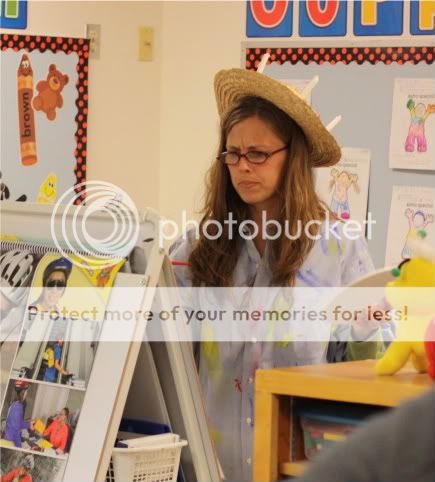
Meet Alicia. A top-notch teacher, and one of the most loyal friends I've ever had. We drove through rain, sleet, and snow together to teach second grade in two colorful classrooms across from each other. When she writes to me about the start of a new school year, I still get a bit sad and envious. She's here today to give us the scoop on Kindergarten. Thanks, Alicia!
I am Alicia and I teach Kindergarten. Sometimes I feel like there should be a 12-
step program for teachers! All kidding aside, let me start with my credentials. I am
currently teaching in my sixth year. I taught second grade for three years and have
been teaching kindergarten since 2008. I cannot be called a veteran teacher yet,
but I feel I have enough experience under my belt to know what I am talking about. I
feel like I am at a good place in my career. I have been teaching long enough to be
experienced but I am still close enough to college to be up to date on the latest research
and developmentally appropriate practices.
Let me start be telling you a teaching story. Before kindergarten actually starts,
each student has an individual appointment with the teacher to assess the student’s
knowledge. Usually most students are right where they should be. Then there are the
really high students and the really low students. Last year after assessing a certain
student, I went out in the hall to tell the parents that I was concerned. This particular
student only knew the lowercase version of the first letter of his name, knew no
sounds, and could only count to 5. In other words, he was low, low, low. This was the
conversation:
me- “I’m a little concerned. J is pretty low. He knew …but that’s it.”
mom (with and incredulous look on her face)-“Well, yeah. He’s never been to school
before.” (and the tone-oh the tone. I may have sensed a ‘duh’ in there).
me- “uh…”
After a few seconds of literal stunned silence, I told the mom it was probably a matter
of exposure then and we would talk soon to see if he needs extra support. I couldn’t
believe that I had heard that. I didn’t realize that some parents thought they weren’t
responsible for their child’s learning. You are, by the way.
As a mother myself (I have two little ones of my own, Elinor and John [we (
I) love Jane
Austen!]), I cannot even imagine not having an active role in my child’s education. BUT,
it does get overwhelming. Below are the basic concepts your child should know before
kindergarten.
I focused my tips on academic skills. I have broken each of the four areas into two to
three sections: benchmark level, the ideal level, and in some cases, the ideal ideal level.
Alphabet/Phonics (letters and sounds)*Benchmark level - Each student should know at least 12 letters and 4 sounds
when entering kindergarten. We like to say about half the letters and a few sounds.
*Ideal - most letters and at least half the sounds
*Ideal ideal - all letters and sounds
A few tips:
Make sure you teach capitals AND lowercase levels. Most students learn
capitals without much thought of lowercase letters. Most of the letters in our
environment are lowercase yet we focus on the uppercase. In our school district, we only test the lowercase letters. Some students learn the sounds before the letter names. That’s totally OK! If
that happens, I simply switch the benchmark (know at least 12 sounds and 4 letter
names). Focus on what your child is picking up. Also, make sure you start with environmental print (environmental print just means print in the environment such as on cereal boxes, restaurants, store names, etc.). Children need to connect what they are learning with what they already know. Learning needs to be meaningful and real. A good way to make those connections
is to connect to the child’s name. For example-“Oh look! I see an l on the Lowe’s sign! You have an l in your name, Elinor! L says /l/ like Lowe’s.”
Name*Benchmark level- recognize name.
*
Ideal - write name from left to right.
*
Ideal ideal - write name with the first letter capital and the rest lower-case letters.
Ideas:
-Treasure hunt for name strips hidden around the house.
-Make name collages with letters from magazines-especially using environmental
print (E from extra gum, l from lemonade mix, i from IHOP ad, n from Nutella, o from
orange juice container, r from Red Robin ad). Make sure to get matching vowel
sounds. For example, when making Elinor, make sure to find a short vowel sound,
not a long vowel sound.
-Prepare for writing by first starting with fine motor skills. To strengthen fine
motor skills, move around rice, tear paper, snap snaps, button buttons, use scissors,
anything to increase little movements. Then move to writing name in/with things:
make a rice/salt/sugar table with a cookie sheet and let them write their name in
it. Make playdough snakes and make letters out of them. Then graduate into big
writing utensils-markers then crayons and finally pens and pencils. It’s never too
early to show your child the correct grip! When you teach your child to write letters, encourage them to start at the top. Here’s a song we sing in our classroom (sung to the tune If You’re Happy and You Know It):
If you ever write a letter start at the top,
If you ever write a letter start at the top,
If you ever write a letter, then you better, better, better
If you ever write a letter start at the top,
Math*
Benchmark - count to 10.
*
Ideal - count to 25.
*Ideal ideal – count past 25 and recognize numerals at least to 10.
Your child should also be able to count at least 10 objects and to name the basic
colors and basic shapes.
Phonemic Awareness (orally playing with language)*
Benchmark - pick out the rhyme pairs (when given 3-4 choices) 50% of the time.
*
Ideal - pick out the rhyme pairs (when given 3-4 choices) 100% of the time.
*
Ideal ideal - create their own rhyming pairs.
You should also work on beginning and ending sounds. One thing to remember is that
phonemic awareness is strictly oral. Once you write it down it becomes phonics. This
is the most fun area in my opinion (and the easiest, too!). While you are driving in the
car you can make up silly rhymes. You can change the beginning sound of everything
you see. If you see a car, a fire engine, a store, and a dog, change them all to start with
a /b/ sound. “I see a bar, a bire bengine, a bore, and a bog.” Trust me, your children
will think it’s a game and will be learning so much!
Other helpful things:Students should know their full name, phone number, and address. It is SUPER helpful if your child can put on and tie his/her shoes. He/she also needs to be able to zip up pants and coats.
Lastly, I want to say that you are the parent. You know your child. You know what your
child can and cannot do. Please use this as your guide, not as something to stress
you or your child. Please, please, please do not push your child. Do not sit and do
flashcards with your preschool-aged child unless your child genuinely enjoys it. But, you
also need to make sure they are exposed to many things and when they are ready, be
there to teach them. Learning-especially for the younger students-needs to be fun. My
goal as a Kindergarten teacher is to meet my students needs academically and socially,
but most importantly to help the students LOVE learning. That should be a big part of
your job, too. Teachers cannot do it all.
Lastly lastly, I want to say a little about development. Each child develops at a different
pace. If you are concerned about a learning disorder, make sure you talk to someone.
There are so many resources available now! And if it is severe, there are preschool
programs available for free through most school districts across the nation. If you are
concerned but not sure, my advice is to wait and see. I tell my parents who have low
students to wait until the end of the first term and then we will reevaluate. So many
times students just click one day. They may just need a different experience with the
skills, more practice, social tutoring, etc. However, if your child still does not meet the
above ideas by mid kindergarten, I would really talk to your teacher and/or the school
principal. But that is my own opinion - trust your parental instinct.
Here are some helpful links:playdough recipeStarfall (I love that Anne has mentioned it before-this is what we do at computers in
kindergarten.)
Making Learning Fun-lots of great ideas for younger children.
uen.org - this is the Utah specific curriculum, but I am sure you can find your
own state’s core curriculum by Googling it.
Thank you so much for this, Alicia! Even for mothers without Kindergarteners this year, this is definitely one to bookmark for the future!